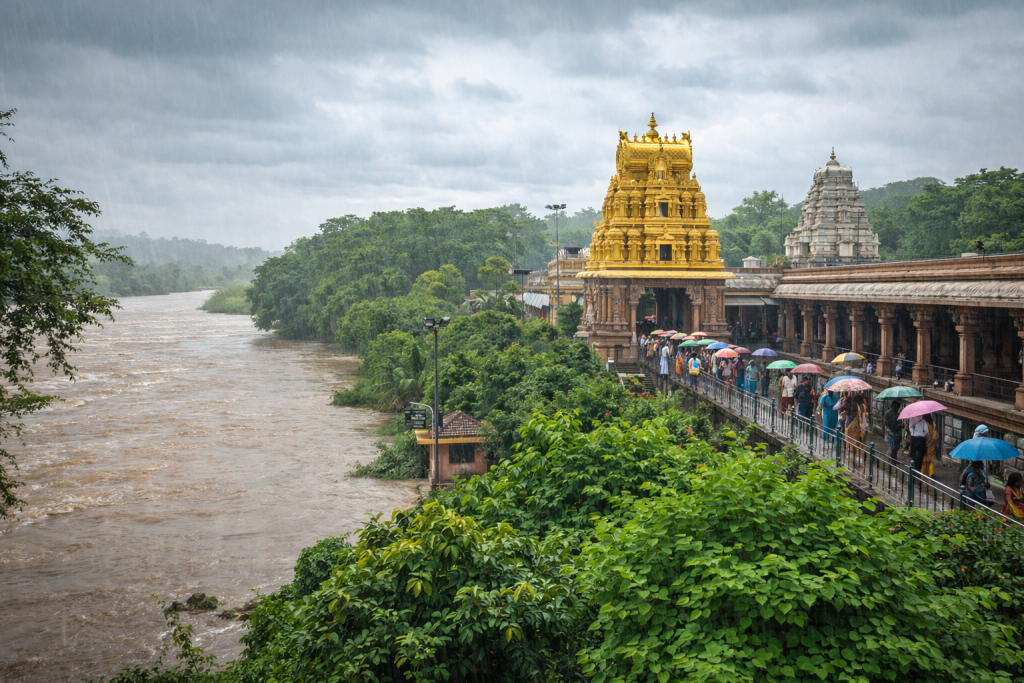
Mantralayam Visit During Rainy Season – 12 Tips, Precautions, and Everything You Should Know Before Going
The phone call came at 6 AM. A family of six from Chennai had reached Mantralayam Road railway station in August, only to find that the auto drivers were refusing to go into town. The Tungabhadra was in spate. The low-lying road between the station and the temple had 18 inches of water across a 200-metre stretch. Their hotel booking was confirmed. Their return tickets were fixed. And nobody — not the travel agent, not the hotel, not the railway — had warned them that a Mantralayam visit during rainy season comes with this particular risk.
They eventually made it. A local tractor operator ferried families across the flooded stretch for ₹50 per person. The temple was open. Darshan happened. And once they were inside the town, the rain actually made the experience beautiful — cool breeze instead of the usual Rayalaseema furnace heat, the Tungabhadra flowing full and magnificent, green fields surrounding the temple complex, and remarkably thin crowds at the Brindavanam.
That story captures everything about a Mantralayam visit during rainy season in one anecdote: it’s unpredictable, occasionally inconvenient, sometimes genuinely challenging — but also uniquely beautiful and spiritually rewarding in ways the other seasons can’t match. The problem isn’t the rain itself. The problem is going unprepared.
Your Mantralayam visit during rainy season can be one of the most peaceful and memorable pilgrimage experiences of your life — if you know what to expect, what to pack, when to go, and what to avoid. I’ve put together 12 specific tips covering every aspect of planning a Mantralayam visit during rainy season: weather patterns, Tungabhadra river conditions, road and transport situations, temple access during rains, accommodation choices, packing essentials, and health precautions.
Every year between June and October, the character of Mantralayam transforms completely. The scorched brown landscape turns lush green. The Tungabhadra — often reduced to a trickle in summer — swells into a wide, powerful river. The temple complex is washed clean by daily showers. And the crowds thin dramatically, giving devotees a quieter, more intimate darshan experience. A Mantralayam visit during rainy season offers something that the peak pilgrimage season (October-February) simply cannot — solitude with Sri Raghavendra Swamy.
But the monsoon also brings real challenges that can disrupt or even cancel your trip if you’re not prepared. This guide ensures that doesn’t happen to you.
Table of Contents
- Mantralayam Rainy Season Weather — Month-by-Month Guide
- The Tungabhadra Factor — The Biggest Risk During Your Mantralayam Visit During Rainy Season
- Tip 1-4: Travel Planning for Your Mantralayam Visit During Rainy Season
- Tip 5-8: Temple Darshan and Daily Activities During Monsoon
- Tip 9-12: Health, Safety, and Packing for Mantralayam Visit During Rainy Season
- Best Month to Plan Your Mantralayam Visit During Rainy Season
- Accommodation Tips for Mantralayam During Monsoon
- Aradhana Mahotsavam — The Grand Festival During Rainy Season
- What to Pack — The Complete Monsoon Packing Checklist
- Nearby Places You Can Visit from Mantralayam During Rainy Season
- FAQ — Mantralayam Visit During Rainy Season
Mantralayam Rainy Season Weather — Month-by-Month Guide
The first step in planning your Mantralayam visit during rainy season is understanding the rainfall pattern. Mantralayam receives rain from both the Southwest Monsoon (June-September) and the Northeast Monsoon (October-November), but the intensity, timing, and impact on your visit differ dramatically by month.
Monthly monsoon data for Mantralayam:
| Month | Avg Rainfall (mm) | Rainy Days | Temperature (°C) | Tungabhadra Level | Travel Risk |
|---|---|---|---|---|---|
| June (late) | 60-80 mm | 5-7 days | 34-38°C | Rising — moderate flow | 🟡 Low — rains just beginning |
| July | 100-140 mm | 8-12 days | 30-35°C | High — strong current | 🟠 Medium — river flooding possible |
| August | 120-160 mm | 10-14 days | 29-34°C | Peak — flood risk highest | 🔴 High — road flooding likely |
| September | 140-180 mm | 12-15 days | 29-33°C | High to very high | 🔴 High — heaviest rainfall month |
| October | 80-120 mm | 6-10 days | 30-34°C | Gradually receding | 🟠 Medium — NE monsoon showers |
| November (early) | 30-60 mm | 3-5 days | 28-32°C | Low — receding to normal | 🟡 Low — pleasant, occasional rain |
What the rain actually feels like during a Mantralayam visit during rainy season:
Unlike the constant drizzle of Kerala or coastal Karnataka, Mantralayam’s monsoon comes in intense bursts. You might wake up to a clear sky at 6 AM, complete your darshan by 8 AM under pleasant clouds, and then get caught in a torrential 45-minute downpour at 10 AM that floods the streets with ankle-deep water. By noon, the sun might be out again. This pattern — heavy bursts followed by clearing — defines the Mantralayam visit during rainy season experience.
The rain isn’t the problem. The aftermath is. Mantralayam town has limited storm drainage. Water accumulates on roads, in low-lying areas, and especially on the road between Mantralayam Road station and the temple town. After a heavy spell, walking through the town means navigating puddles, mud patches, and occasionally flowing water across the road.
Quick Tip: Check the weather forecast for Kurnool district 3-5 days before your planned Mantralayam visit during rainy season. If heavy rainfall warnings are issued by IMD (India Meteorological Department), consider rescheduling by a few days rather than arriving during the worst spell.
The Tungabhadra Factor — The Biggest Risk During Your Mantralayam Visit During Rainy Season
The Tungabhadra river is both the spiritual heart of Mantralayam and the single biggest risk factor during monsoon. The river that pilgrims bathe in during peaceful winter mornings becomes a powerful, fast-flowing, muddy torrent during the rainy season — and its behaviour directly determines whether your Mantralayam visit during rainy season goes smoothly or gets disrupted.
How the Tungabhadra affects your Mantralayam visit during rainy season:
| Situation | Impact | Likelihood (Jul-Sep) |
|---|---|---|
| Normal monsoon flow | River full but within banks. Temple area unaffected. All roads open. River ghat closed for bathing but viewable. | 50-60% of days |
| Moderate flooding | Low-lying areas near river waterlogged. Access road from railway station partially flooded (ankle-deep). Temple complex dry and accessible. | 25-30% of days |
| Heavy flooding (Tungabhadra in spate) | River breaches banks in some sections. Station-to-town road flooded (knee-deep). Some hotels near river ghat waterlogged. Temple complex on higher ground remains accessible but approach may require wading. | 10-15% of days |
| Severe flooding (rare but happens) | Entire low-lying town sections submerged. Road access cut off temporarily (6-24 hours). Temple may suspend operations briefly. Evacuation of riverside accommodations. | 2-5% of days |
Critical detail for your Mantralayam visit during rainy season: The temple complex and the Brindavanam sit on relatively elevated ground compared to the river and the town’s low-lying areas. Even during moderate flooding, the temple typically remains accessible and operational. The disruption is almost always about getting TO the temple — not about the temple itself being affected.
How to monitor Tungabhadra conditions before your Mantralayam visit during rainy season:
- Check Tungabhadra Dam water release announcements from Karnataka (upstream dam releases increase river levels at Mantralayam within 12-24 hours)
- Follow Kurnool District Administration social media accounts for flood alerts
- Call your hotel 1-2 days before arrival — they’ll know current conditions better than any weather app
- Check AP State Disaster Management Authority updates during heavy rain periods
Quick Tip: The Tungabhadra at Mantralayam reacts to dam releases upstream in Karnataka, not just local rainfall. Your Mantralayam visit during rainy season can be disrupted by heavy rain in Shimoga district (300 km upstream) even if Mantralayam itself is dry. Always check dam release status before travelling.
Tip 1-4: Travel Planning for Your Mantralayam Visit During Rainy Season
Tip 1: Keep Your Travel Dates Flexible — Don’t Lock Fixed Return Tickets
This is the most important travel tip for a Mantralayam visit during rainy season. Fixed, non-refundable return tickets become a source of stress if rain disrupts access. I’ve seen pilgrims stranded at the station watching their train depart because they couldn’t reach the platform through flooded roads, and others stuck in Mantralayam unable to leave because buses were cancelled.
My strong recommendation: book refundable or flexible tickets for your Mantralayam visit during rainy season. If you’re driving, even better — you control your departure timing. If you must book fixed train tickets, keep a 1-day buffer on either side of your planned darshan dates.
Tip 2: Prefer Road Travel Over Rail During Peak Monsoon
The Mantralayam Road railway station sits in a low-lying area that floods more frequently than the main road approaches. During a Mantralayam visit during rainy season, road travel gives you more flexibility:
Travel comparison for Mantralayam visit during rainy season:
| Factor | Road (Bus/Car) | Rail |
|---|---|---|
| Flexibility | Can stop, detour, or turn back if roads flooded | Fixed schedule — train runs regardless of local conditions |
| Last-mile access | Bus stops closer to temple area on higher ground | Station is 5 km from temple in a flood-prone low-lying area |
| Cancellation flexibility | APSRTC allows rescheduling; private car has full flexibility | IRCTC cancellation involves charges and wait |
| Information availability | Driver can assess road conditions in real-time | No information about station-to-town conditions until you arrive |
| Monsoon risk | Some road sections may have water crossing — but alternative routes exist | Station flooding can strand you with no alternative |
Recommended routes for your Mantralayam visit during rainy season:
- From Hyderabad (230 km): NH44 to Kurnool, then SH to Mantralayam — well-maintained highway, rarely floods
- From Bangalore (380 km): NH44 to Kurnool, then SH to Mantralayam — or via Adoni route
- From Chennai (470 km): Via Kurnool is the safest monsoon route — coastal routes flood more frequently
Book your bus on APSRTC or train on IRCTC, but I recommend road travel for monsoon trips.
Tip 3: Start Early — Arrive Before Noon
Most heavy rainfall during a Mantralayam visit during rainy season occurs in the afternoon and evening hours (typically between 2 PM and 8 PM). Mornings are frequently clear or lightly cloudy. Plan your arrival for morning hours — before noon — to avoid travelling during the heaviest rain spells.
If you’re driving, depart your origin city by 4-5 AM for a morning arrival. If taking a bus from Hyderabad or Bangalore, the overnight options work perfectly — you arrive at 5-6 AM, well before afternoon rain begins.
Tip 4: Carry Cash — UPI and Card Machines Fail During Power Cuts
Heavy rain at Mantralayam causes power outages. When power goes, internet connectivity goes with it. UPI payments fail. Card machines go offline. ATMs stop working. During your Mantralayam visit during rainy season, carrying sufficient cash is essential — not just a convenience.
Cash requirements for a Mantralayam visit during rainy season:
| Expense | Estimated Cost |
|---|---|
| Auto from station to temple (if roads clear) | ₹100-200 |
| Auto/tractor during flooding (if roads flooded) | ₹50-200 per person |
| Hotel accommodation (1-2 nights) | ₹800-2,000 per night |
| Meals (per person per day) | ₹300-500 |
| Temple offerings, prasadam | ₹100-500 |
| Emergency buffer | ₹1,000 |
| Total recommended cash | ₹3,000-6,000 per person |
Tip 5-8: Temple Darshan and Daily Activities During Monsoon
Tip 5: Morning Darshan Is Best — Rain Usually Hits After Noon
The darshan pattern for a Mantralayam visit during rainy season is actually easier than summer. Mornings are cool (26-30°C), overcast, and rain-free most days. The temple opens at 6 AM. Morning crowds during monsoon are significantly thinner than peak season. You can complete a peaceful, unhurried darshan of the Brindavanam, Manchale, and Panchamukhi temple all before 8:30 AM — often before the first rain of the day.
Ideal daily schedule for your Mantralayam visit during rainy season:
| Time | Activity | Weather Expectation |
|---|---|---|
| 5:30 AM | Wake up, freshen up | Cool, dry, pleasant |
| 6:00-8:00 AM | Temple darshan — Brindavanam, Manchale, Panchamukhi | Overcast but dry — comfortable for darshan |
| 8:00-9:00 AM | Breakfast at hotel or nearby restaurant | Still dry — light clouds |
| 9:00-12:00 PM | Explore temple complex, visit shops, view Tungabhadra from safe distance | Partly cloudy — occasional light drizzle possible |
| 12:00-2:00 PM | Lunch and rest at hotel | Clouds building — rain likely soon |
| 2:00-5:00 PM | Stay indoors — heavy rain most likely during this window | Heavy showers — streets may flood temporarily |
| 5:00-6:30 PM | Evening darshan if rain clears (often does briefly) | Rain easing — possible clearing |
| 7:00 PM onwards | Dinner, rest | Light rain or dry — evening often pleasant |
Following this schedule means your Mantralayam visit during rainy season involves temple activities during the dry morning hours and indoor rest during the rainy afternoon — comfortable and safe.
Tip 6: The Temple Floor Is Slippery — Walk Carefully
Wet stone floors are dangerously slippery. During a Mantralayam visit during rainy season, the temple complex’s stone pathways become treacherous after every rain spell. Pilgrims walking barefoot (as required inside the temple) on wet stone have slipped and injured themselves — I’ve seen elderly devotees fall on the parikrama path.
Walk slowly and deliberately. Avoid running even if rain suddenly starts. Hold the railing where available. If you’re with elderly family members or small children, hold their hands throughout the temple visit. The wet stone paths around the Brindavanam are the most slippery sections during a Mantralayam visit during rainy season.
Quick Tip: Rubber-soled bathroom slippers with grip provide better traction than barefoot on wet stone. You’ll need to remove them at the Brindavanam sanctum, but you can wear them through the outer complex areas during a Mantralayam visit during rainy season.
Tip 7: Don’t Attempt River Bathing During Monsoon
The Tungabhadra river ghat at Mantralayam is a sacred bathing spot during the dry months. During the rainy season, the river current becomes extremely dangerous. Every monsoon season brings reports of pilgrims swept away by the Tungabhadra’s current across Andhra Pradesh and Karnataka.
During your Mantralayam visit during rainy season, do NOT enter the river — regardless of how manageable the current looks from the bank. The river bottom shifts during floods, creating hidden deep spots. Undercurrents are invisible from the surface. A section that looks ankle-deep may have a 6-foot channel two steps away.
You can view the Tungabhadra from the ghat — the sight of the river in full monsoon flow is spectacular and worth seeing. But keep a safe distance from the waterline. Water levels can rise rapidly with no warning during upstream dam releases.
Tip 8: Carry a Waterproof Bag for Your Phone, Wallet, and Documents
A sudden downpour during your Mantralayam visit during rainy season can soak everything you’re carrying within seconds. A ₹100 waterproof pouch (available on Amazon or at any travel shop) saves your phone, cash, ID cards, and hotel booking printouts from water damage.
Keep your phone in the waterproof pouch at all times when you’re outside during a Mantralayam visit during rainy season — not just when it’s raining. Sudden showers hit with almost no warning, and by the time you reach for a bag, your phone is already wet.
Tip 9-12: Health, Safety, and Packing for Mantralayam Visit During Rainy Season
Tip 9: Mosquito Protection Is Non-Negotiable
Stagnant water from monsoon rain creates breeding grounds for mosquitoes. Mantralayam’s monsoon mosquito population is aggressive — particularly in the evenings. During your Mantralayam visit during rainy season, mosquito-borne diseases (dengue, malaria, chikungunya) are a real health risk, not just an annoyance.
Mosquito protection essentials for your Mantralayam visit during rainy season:
- Apply mosquito repellent cream (Odomos or similar) on all exposed skin — reapply every 4 hours
- Carry a personal mosquito repellent patch or band for children
- Wear full-length clothing in the evenings — cover arms and legs
- Choose hotel rooms with intact mosquito mesh on windows
- Request a mosquito coil or electric repellent from your hotel
- Avoid standing near stagnant water pools, especially at dusk
Quick Tip: Mosquitoes at Mantralayam during monsoon are most active between 5:30-8:00 PM — exactly when you might be doing your evening darshan. Apply repellent before your evening temple visit.
Tip 10: Wear Waterproof Footwear With Good Grip
Your footwear choice can make or break your Mantralayam visit during rainy season. Regular sandals become slippery. Shoes get waterlogged and heavy. Leather footwear gets ruined. The ideal monsoon footwear is waterproof rubber sandals with textured soles that grip wet surfaces.
Footwear recommendations for Mantralayam visit during rainy season:
| Footwear | Rating | Why |
|---|---|---|
| Rubber sports sandals (Crocs/similar) | ⭐⭐⭐⭐⭐ | Waterproof, quick-dry, good grip, easy to remove at temple |
| Waterproof trekking sandals | ⭐⭐⭐⭐ | Excellent grip, durable, but slower to remove at temple |
| Regular rubber chappals (Hawaii) | ⭐⭐⭐ | Waterproof but poor grip on wet stone — slipping risk |
| Leather sandals | ⭐ | Get ruined by water, become slippery, take days to dry |
| Sports shoes/sneakers | ⭐ | Get waterlogged, heavy, take forever to dry, uncomfortable |
| Bathroom slippers with grip | ⭐⭐⭐⭐ | Good for temple complex wet floors, easy on/off, affordable |
Tip 11: Carry Medicines for Monsoon-Related Illnesses
Monsoon travel carries specific health risks. Pack these medicines for your Mantralayam visit during rainy season (consult your doctor for prescriptions where needed):
| Medicine | Purpose | Why You Need It During Monsoon |
|---|---|---|
| Anti-diarrhoeal (Loperamide) | Loose motions from contaminated water/food | Water quality issues increase during monsoon |
| ORS packets | Rehydration | Diarrhoea or vomiting can cause rapid dehydration |
| Paracetamol | Fever, body ache | Viral fevers are common during monsoon at Mantralayam |
| Antihistamine (Cetirizine) | Cold, allergic reactions | Wet weather triggers allergies; insect bites cause reactions |
| Antifungal cream | Fungal skin infections | Wet conditions between toes and in skin folds cause fungal growth |
| Mosquito repellent | Mosquito bite prevention | Dengue and malaria mosquitoes peak during monsoon |
| Band-aids / antiseptic | Cuts and scrapes | Wet, slippery surfaces increase minor injury risk |
Tip 12: Keep Your Hotel’s Contact Number and Location Saved Offline
During your Mantralayam visit during rainy season, internet connectivity can be unreliable — particularly during heavy rain and power outages. Mobile data becomes patchy. Google Maps may not load. If you’re caught in rain in an unfamiliar part of town, having your hotel’s phone number and address saved as a screenshot (not relying on an app) can save you a lot of confusion.
Before leaving your hotel each day during a Mantralayam visit during rainy season, save your hotel name, address, room number, and the hotel’s phone number as a screenshot on your phone. Also note the nearest landmark. This simple precaution has helped many travellers find their way back during heavy rain when navigation apps fail.
Best Month to Plan Your Mantralayam Visit During Rainy Season
If you have flexibility, here’s my honest month-by-month recommendation for timing your Mantralayam visit during rainy season:
🏆 Best: Late June or November (early)
Late June marks the monsoon’s arrival at Mantralayam — the landscape begins greening, temperatures drop from summer extremes to 34-38°C, rainfall is light and infrequent, the Tungabhadra is rising but within banks, and travel disruption risk is minimal. Early November offers the tail end of the monsoon with pleasant 28-32°C weather, occasional light showers, and the post-monsoon green landscape still intact. Both periods give you the beauty of a Mantralayam visit during rainy season without the peak monsoon risks.
✅ Good: July or October
July brings regular rain but manageable conditions. The Tungabhadra is full and beautiful. Crowds are thin. October’s Northeast Monsoon showers are less intense than the July-September Southwest Monsoon. A Mantralayam visit during rainy season in either month is comfortable with proper preparation.
⚠️ Challenging: August or September
These are peak monsoon months. Rainfall is heaviest (120-180 mm). Tungabhadra flooding risk is highest. Road disruptions are most likely. If your Mantralayam visit during rainy season falls in August-September, follow every tip in this article rigorously — and keep your schedule flexible.
The one exception: If your Mantralayam visit during rainy season is specifically for Aradhana Mahotsavam (July-August), the timing is fixed by the festival calendar. In that case, prepare thoroughly and plan for monsoon conditions — the spiritual experience is absolutely worth the weather challenges.
Accommodation Tips for Mantralayam During Monsoon
Choosing the right hotel significantly impacts your Mantralayam visit during rainy season comfort and safety.
What to look for in monsoon accommodation at Mantralayam:
| Factor | What to Check | Why It Matters |
|---|---|---|
| Elevation | Hotel should be on higher ground — NOT near the river ghat or in low-lying areas | Low-lying hotels flood during heavy rain; higher-ground hotels stay dry |
| Generator/inverter backup | Ask if the hotel has power backup — power cuts are frequent during monsoon | Without backup, you lose AC, fans, lights, and phone charging during outages |
| Mosquito protection | Windows should have mesh/screens; room should have mosquito coil or electric repellent | Monsoon mosquitoes are aggressive — unprotected rooms are miserable at night |
| Drying facilities | Ask if rooms have a clothesline or hooks for drying wet clothes | Your clothes WILL get wet during a Mantralayam visit during rainy season |
| Hot water | Confirm hot water availability — useful for warm showers after getting drenched | Getting thoroughly wet and then not being able to warm up leads to illness |
| Ground floor vs upper floor | Request upper floor rooms during monsoon | Ground floor rooms in some older hotels can get water seepage during heavy rain |
Recommended accommodation for your Mantralayam visit during rainy season:
| Hotel | Monsoon Suitability | Rate (approx) | Notes |
|---|---|---|---|
| Hotel Raghavendra Residency | ⭐⭐⭐⭐⭐ | ₹1,200-2,000 | Higher ground, generator backup, AC rooms |
| Sri Raghavendra Comforts | ⭐⭐⭐⭐ | ₹800-1,500 | Close to temple, AC rooms available |
| Temple choultries (higher section) | ⭐⭐⭐ | ₹300-1,000 | Within complex but basic amenities — check room condition |
| APTDC Hotel | ⭐⭐⭐⭐ | ₹1,000-1,800 | Government-run, reliable power backup, book online |
The good news about accommodation during your Mantralayam visit during rainy season: rooms are much easier to find than peak season (October-February) or summer holidays (May). You’ll have better availability and sometimes lower rates.
For more accommodation details, check our guide on best hotels near Mantralayam temple and budget stays in Mantralayam.
Aradhana Mahotsavam — The Grand Festival During Rainy Season
The Aradhana Mahotsavam is THE reason many devotees plan their Mantralayam visit during rainy season despite the monsoon challenges. This annual festival — commemorating the jeeva samadhi of Sri Raghavendra Swamy — typically falls in the Shravana month (July-August) and draws lakhs of pilgrims over a 2-3 day celebration.
What to expect during Aradhana at Mantralayam:
| Aspect | Detail |
|---|---|
| Timing | Shravana Krishna Paksha Dwitiya — typically late July or August (exact date varies by Hindu calendar) |
| Duration | 2-3 days of main celebrations with preparatory events starting a week earlier |
| Crowd size | 2-5 lakh pilgrims over the festival period — the largest gathering at Mantralayam all year |
| Darshan queue | 4-8 hours during peak festival days — compared to 15-30 minutes on regular monsoon days |
| Special events | Grand Abhishekam at the Brindavanam, special pujas, cultural programmes, mass Annadanam |
| Weather likelihood | High probability of rain — July/August are peak monsoon months |
| Accommodation | FULLY booked weeks in advance — book 1-2 months early or plan for day trip |
Tips specifically for Aradhana during your Mantralayam visit during rainy season:
Your Mantralayam visit during rainy season for Aradhana requires extra preparation because you’re combining peak monsoon conditions with peak crowd conditions. Book accommodation at least 4-6 weeks in advance. Carry more cash than usual (ATMs run out during festivals). Bring waterproof bags for ALL your belongings — standing in a 4-8 hour darshan queue during a rain burst with no protection will soak everything. Wear waterproof footwear you can easily slip on and off. And most critically: carry patience. The darshan queue during Aradhana combined with rain is a test of devotion that Sri Raghavendra’s devotees approach with joy, not frustration.
For temple schedules, check our Mantralayam temple darshan timings guide.
What to Pack — The Complete Monsoon Packing Checklist
Your Mantralayam visit during rainy season packing list — don’t leave home without these:
| Category | Items | Priority |
|---|---|---|
| Rain protection | Compact umbrella (sturdy, wind-resistant), lightweight rain poncho/raincoat, waterproof bag cover for backpack | 🔴 Essential |
| Waterproof storage | Zip-lock bags (large, for phone/wallet/documents), waterproof phone pouch, plastic bags for wet clothes | 🔴 Essential |
| Footwear | Waterproof rubber sandals with grip (primary), bathroom slippers with grip (temple use) | 🔴 Essential |
| Clothing | Quick-dry fabric clothes (2-3 extra sets — you WILL get wet), full-length evening wear (mosquito protection) | 🔴 Essential |
| Mosquito protection | Repellent cream (Odomos), patches/bands for children, personal electric repellent | 🔴 Essential |
| Medicine kit | Anti-diarrhoeal, ORS, paracetamol, antihistamine, antifungal cream, band-aids, antiseptic | 🟠 Important |
| Cash | ₹3,000-6,000 per person in small denominations (UPI may fail during power cuts) | 🔴 Essential |
| Electronics | Power bank (10,000+ mAh), waterproof phone pouch, offline maps downloaded | 🟠 Important |
| Comfort | Small towel (quick-dry type), hand sanitiser, tissue/wet wipes | 🟡 Recommended |
Quick Tip: Roll your clothes in plastic bags before packing them in your main bag for a Mantralayam visit during rainy season. Even if your bag gets soaked, your clothes stay dry. This simple trick has saved many monsoon travellers.
Nearby Places You Can Visit from Mantralayam During Rainy Season
The monsoon transforms the landscape around Mantralayam. Places that look barren and scorched in summer become green and beautiful during the rains. If your Mantralayam visit during rainy season spans 2-3 days, consider these nearby attractions:
| Place | Distance | Monsoon Appeal | Caution |
|---|---|---|---|
| Tungabhadra River viewpoint | 1 km | Spectacular — river in full monsoon glory, powerful current, mist rising | View from safe distance ONLY — do not approach waterline |
| Panchamukhi Temple | 500m | Peaceful monsoon darshan with thin crowds | Wet stone floors — walk carefully |
| Manchale | Within complex | Serene during rain — beautiful when mist settles over the complex | Slippery path during/after rain |
| Belum Caves | 130 km | Perfect monsoon day trip — caves are naturally dry (16-18°C inside) regardless of weather outside | Road to Belum occasionally has water crossings in heavy monsoon — check before going |
| Yaganti Temple | 100 km | Stunning during monsoon — green hills, waterfalls on the way, cave temple atmosphere enhanced by mist | Hill road can be slippery — drive carefully |
| Kurnool Fort | 75 km | Historical fort with monsoon clouds creating dramatic backdrop | Some sections may be slippery when wet |
| Mahanandi Temple | 120 km | Natural spring here is at its fullest during monsoon — the water is beautifully clear | Road conditions vary — confirm before travelling |
Quick Tip: Belum Caves (130 km from Mantralayam) is the perfect day trip during your Mantralayam visit during rainy season because the underground caves are completely unaffected by rain. The temperature inside stays at 16-18°C regardless of weather, and the stalactite/stalagmite formations are the second longest in India.
For full travel route information, see our guide on how to reach Mantralayam and places to visit near Mantralayam.
FAQ — Mantralayam Visit During Rainy Season
Is Mantralayam temple open during rainy season?
Yes — the Mantralayam temple remains open during rainy season and operates on its regular darshan schedule throughout the monsoon months (June-November). The Brindavanam darshan, Manchale, Panchamukhi temple, and all regular pujas continue as normal. In rare cases of severe flooding (2-5% of monsoon days), temple operations may be briefly suspended for a few hours until water recedes, but full closures lasting more than a day are extremely rare. Your Mantralayam visit during rainy season will almost certainly include normal darshan — the disruption risk is about reaching the temple, not the temple being closed. Morning darshan (6:00-8:00 AM) is the best slot because mornings are typically dry even during peak monsoon.
Does it flood in Mantralayam during monsoon?
Flooding does occur during a Mantralayam visit during rainy season, primarily in two areas: the road between Mantralayam Road railway station and the temple town (a low-lying stretch that floods with even moderate rainfall), and the areas near the Tungabhadra river ghat (which flood when the river rises). The temple complex itself sits on relatively higher ground and is rarely directly affected. During August-September (peak monsoon), moderate road flooding occurs on 25-30% of days and severe flooding on 2-5% of days. The flooding is usually temporary — water recedes within 6-24 hours after heavy rain stops. Locals use tractors and high-clearance vehicles to transport pilgrims across flooded stretches. Your Mantralayam visit during rainy season requires flexibility, but complete trip cancellation due to flooding is uncommon.
What should I wear for Mantralayam visit during rainy season?
For your Mantralayam visit during rainy season, wear quick-dry fabric clothing that won’t stay wet and heavy after a downpour. Avoid cotton — it absorbs water, becomes heavy, and takes hours to dry. Synthetic quick-dry fabrics or cotton-polyester blends are ideal. Wear full-length clothing in the evenings to protect against mosquito bites. For footwear, waterproof rubber sandals with textured grip soles are the best option — they handle rain, puddles, and wet temple floors while being easy to remove for darshan. Carry 2-3 extra sets of clothing because you will get wet at least once during your visit. Pack wet clothes in separate plastic bags to keep your dry clothes safe.