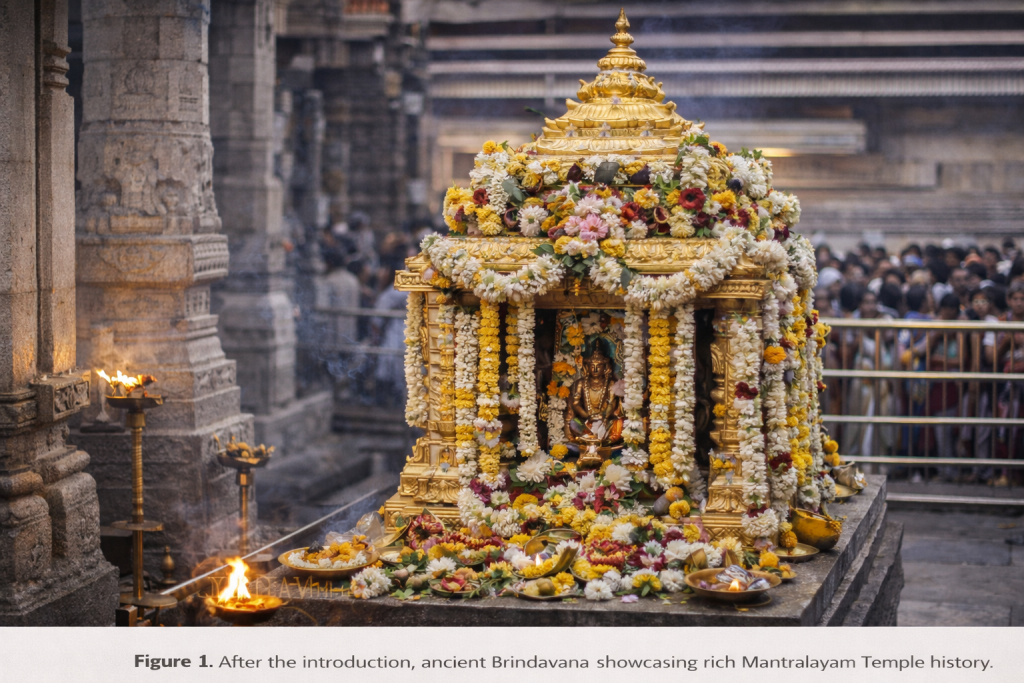
The first time I heard the Mantralayam Temple history, I was sitting beside my grandmother on a warm summer evening. She told me about a saint who entered his own tomb alive, promising to bless devotees for 700 years. I was just 8 years old then, and the story gave me goosebumps.
Decades later, standing before the sacred Brindavana at Mantralayam, those childhood memories came flooding back. The Mantralayam Temple history is not just about dates and events—it’s a living testament to faith, miracles, and divine grace that continues to transform lives.
[Image 1: Ancient Mantralayam Temple Brindavana showcasing rich Mantralayam Temple history]
Every year, millions of devotees visit this sacred shrine on the banks of the Tungabhadra River. But how many truly know the extraordinary Mantralayam Temple history? The story spans over 350 years and involves one of the most remarkable saints in Indian spiritual tradition.
This guide presents the complete Mantralayam Temple history in English—from the birth of Sri Raghavendra Swamy to the miraculous events that continue to this day. Whether you’re planning a pilgrimage or simply curious about this sacred place, understanding its history deepens the spiritual experience.
Let me take you through this incredible journey through time.
Table of Contents
- Introduction to Mantralayam Temple History
- The Birth of Sri Raghavendra Swamy
- Mantralayam Temple History: Early Life and Education
- The Transformation: From Householder to Saint
- Mantralayam Temple History: Becoming the Pontiff
- Miracles During Sri Raghavendra’s Lifetime
- Mantralayam Temple History: The Sacred Entry into Brindavana
- The 700-Year Promise
- Mantralayam Temple History: Development Over Centuries
- Modern Era and Temple Administration
- Mantralayam Temple History: Miracles and Divine Experiences
- Frequently Asked Questions
Introduction to Mantralayam Temple History
The Mantralayam Temple history begins with understanding what makes this place unique in Indian spirituality.
What Makes Mantralayam Special?
| Aspect | Significance |
|---|
| Type | Brindavana (living samadhi) |
| Saint | Sri Raghavendra Swamy |
| Belief | Saint is alive in meditation |
| Duration | 700-year promise (1671-2371) |
| Location | Tungabhadra River bank |
Key Facts About Mantralayam Temple History
| Fact | Detail |
|---|
| Established | 1671 CE |
| Age | 354 years (as of 2025) |
| Founder | Sri Raghavendra Swamy |
| Philosophy | Dvaita (Madhwa) tradition |
| Daily visitors | 10,000-50,000 |
| Annual visitors | 10+ million |
Timeline Overview
| Year | Event |
|---|
| 1595 | Birth of Venkatanatha (later Raghavendra) |
| 1621 | Became a sannyasi |
| 1623 | Became pontiff of Kumbakonam Mutt |
| 1671 | Entered Brindavana at Mantralayam |
| 1800s | Temple expansion began |
| 1900s | Major renovations |
| 2000s | Modern facilities added |
The Mantralayam Temple history spans over four centuries of devotion and divine grace.
The Birth of Sri Raghavendra Swamy
The Mantralayam Temple history truly begins with the birth of an extraordinary soul.
Birth Details
| Detail | Information |
|---|
| Birth name | Venkatanatha |
| Birth year | 1595 CE |
| Birth place | Bhuvanagiri, Tamil Nadu |
| Father | Thimanna Bhatta |
| Mother | Gopikamba |
| Nakshatra | Mrigashira |
| Family lineage | Gautama Gotra |
Family Background
| Aspect | Details |
|---|
| Caste | Deshastha Brahmin |
| Tradition | Madhwa (Dvaita) |
| Occupation | Vedic scholars, priests |
| Ancestors | Devoted to Lord Vishnu |
| Economic status | Modest, scholarly family |
Divine Signs at Birth
According to Mantralayam Temple history, several auspicious signs appeared at Venkatanatha’s birth:
| Sign | Interpretation |
|---|
| Bright star visible | Divine soul descending |
| Sweet fragrance | Presence of deities |
| Easy delivery | Blessed child |
| Child born calm | Saintly temperament |
Previous Birth Connection
| Belief | Details |
|---|
| Previous incarnation | Prahlada (devotee of Lord Vishnu) |
| Before that | Vyasa Raja (great Madhwa saint) |
| Before that | Shankukarna (celestial being) |
| Purpose | To continue serving humanity |
This belief forms a significant part of Mantralayam Temple history and explains the saint’s extraordinary powers.
Mantralayam Temple History: Early Life and Education
The formative years that shaped the saint central to Mantralayam Temple history.
Childhood Years
| Period | Events |
|---|
| Age 0-5 | Showed remarkable intelligence |
| Age 5-8 | Learned to read Sanskrit scriptures |
| Age 8 | Upanayana (sacred thread ceremony) |
| Age 8-16 | Intensive Vedic education |
Education Details
| Subject | Achievement |
|---|
| Vedas | Mastered all four Vedas |
| Upanishads | Complete knowledge |
| Sanskrit | Exceptional fluency |
| Logic (Nyaya) | Expert debater |
| Grammar | Mastered Panini’s work |
| Philosophy | Deep understanding of Dvaita |
Guru and Learning
| Guru | Teaching |
|---|
| Sudhindra Tirtha | Primary spiritual master |
| Local scholars | Vedic recitation |
| Father | Initial education |
Marriage and Householder Life
| Detail | Information |
|---|
| Marriage age | Around 16-18 years |
| Wife’s name | Saraswati |
| Children | One son (Lakshminarayana) |
| Occupation | Vedic teaching, pujas |
| Duration | Approximately 25 years |
Scholarly Achievements as Householder
| Achievement | Significance |
|---|
| Wrote commentaries | On Upanishads |
| Taught students | Spread Vedic knowledge |
| Won debates | Against rival scholars |
| Composed hymns | Devotional poetry |
The educational foundation laid during this period is essential to understanding Mantralayam Temple history.
The Transformation: From Householder to Saint
A pivotal chapter in Mantralayam Temple history—the renunciation.
Why Renunciation?
| Factor | Explanation |
|---|
| Wife’s death | Saraswati passed away |
| Spiritual calling | Inner urge for higher purpose |
| Guru’s wish | Sudhindra Tirtha’s guidance |
| Destiny | Fulfill previous life’s mission |
The Renunciation Process
| Stage | Events |
|---|
| Decision | Approached Guru Sudhindra Tirtha |
| Preparation | Arranged for son’s future |
| Ceremony | Formal sannyasa initiation |
| New name | Given “Raghavendra Tirtha” |
| Year | 1621 CE |
Sannyasa Details
| Aspect | Information |
|---|
| Initiation place | Kumbakonam |
| Initiating guru | Sudhindra Tirtha |
| Sannyasa name | Raghavendra Tirtha |
| Age at sannyasa | Approximately 26 years |
| Tradition | Madhwa Sannyasa Parampara |
Significance of the Name “Raghavendra”
| Element | Meaning |
|---|
| Raghu | Lord Rama’s dynasty |
| Indra | Lord/King |
| Combined | “Lord of Raghu’s lineage” |
| Implication | Devotee of Lord Rama |
This transformation marks a turning point in Mantralayam Temple history.
Mantralayam Temple History: Becoming the Pontiff
How Sri Raghavendra became the head of the prestigious Mutt.
Succession to Peetham
| Detail | Information |
|---|
| Previous pontiff | Sudhindra Tirtha |
| Year of succession | 1623 CE |
| Location | Kumbakonam Mutt |
| Peetham lineage | Madhwa tradition |
| Position number | 24th pontiff |
Responsibilities as Pontiff
| Duty | Description |
|---|
| Spiritual leadership | Guide disciples |
| Temple management | Oversee rituals |
| Teaching | Spread Dvaita philosophy |
| Writing | Compose scholarly works |
| Travel | Visit devotees across regions |
Literary Contributions
| Work | Subject |
|---|
| Parimala | Commentary on Vedanta |
| Tantra Deepika | Ritual procedures |
| Bhatta Sangraha | Philosophical text |
| Mantrartha Manjari | Mantra explanations |
| Pramayana Navaneeta | Logic treatise |
| 50+ other works | Various subjects |
Travels and Influence
| Region | Activities |
|---|
| Tamil Nadu | Established centers |
| Karnataka | Spread teachings |
| Andhra Pradesh | Gained followers |
| Maharashtra | Visited devotees |
Duration as Pontiff
| Detail | Information |
|---|
| Started | 1623 CE |
| Ended | 1671 CE (Brindavana entry) |
| Total years | 48 years |
| Successors appointed | Multiple |
The pontiff years form a major chapter in Mantralayam Temple history, establishing the foundation for the institution.
Miracles During Sri Raghavendra’s Lifetime
Documented miracles that form part of Mantralayam Temple history.
Famous Miracles
| Miracle | Description |
|---|
| Reviving the dead | Brought a boy back to life |
| Curing diseases | Healed incurable ailments |
| Feeding thousands | Food multiplied miraculously |
| Stopping rain | Protected devotees |
| Producing water | In drought conditions |
The Miracle of the Dead Boy
| Detail | Event |
|---|
| Location | Near Kumbakonam |
| Situation | Boy bitten by snake, died |
| Parents | Brought body to Swamy |
| Action | Swamy chanted mantras |
| Result | Boy revived completely |
The Nawab’s Test
| Detail | Event |
|---|
| Challenger | Local Nawab (Muslim ruler) |
| Test | Prove divine power |
| Challenge | Make lamp burn with water |
| Result | Lamp burned with water |
| Outcome | Nawab became devotee |
Feeding Miracle at Bijapur
| Detail | Event |
|---|
| Situation | Large crowd, limited food |
| Problem | Not enough to feed all |
| Swamy’s action | Blessed the food |
| Result | Food never depleted |
| Witnesses | Hundreds of devotees |
Documented Miracle Count
| Category | Number |
|---|
| Healing miracles | 100+ documented |
| Nature control | 20+ incidents |
| Food multiplication | 15+ occasions |
| Revival from death | 3 documented cases |
| Other miracles | Countless |
These miracles are integral to Mantralayam Temple history and continue to inspire faith.
Mantralayam Temple History: The Sacred Entry into Brindavana
The most significant event in Mantralayam Temple history—the living samadhi.
Decision to Enter Brindavana
| Factor | Explanation |
|---|
| Age | 76 years old |
| Mission | Felt life’s purpose fulfilled |
| Divine guidance | Instructed in meditation |
| Desire | Continue blessing devotees |
| Timing | Auspicious Shravana month |
Choosing Mantralayam
| Reason | Explanation |
|---|
| Sacred location | On Tungabhadra River |
| Previous connection | Visited during travels |
| Divine indication | Received in meditation |
| Accessibility | Reachable for devotees |
| Spiritual energy | Strong positive vibrations |
Preparation for Brindavana Entry
| Day | Activity |
|---|
| Day 1-10 | Fasting, meditation |
| Day 11-15 | Teaching final lessons |
| Day 16-20 | Blessing disciples |
| Day 21-25 | Final rituals |
| Day 26-30 | Entering Brindavana |
The Final Day: August 1671
| Time | Event |
|---|
| Early morning | Final bath in Tungabhadra |
| Morning | Last discourse to disciples |
| Mid-morning | Final blessings given |
| Noon | Entered the prepared pit |
| Afternoon | Sat in padmasana (lotus position) |
| Evening | Brindavana sealed |
Construction of Brindavana
| Element | Detail |
|---|
| Material | Sacred salagramas (1,200) |
| Structure | Stone enclosure |
| Position | Saint sitting in meditation |
| Covering | Stone slabs |
| Additions | Gold and silver later |
Eyewitness Accounts
| Witness | Testimony |
|---|
| Disciples | “Saw divine light emanate” |
| Villagers | “Heard mantras for 12 years after” |
| Later visitors | “Feel living presence” |
This event is the cornerstone of Mantralayam Temple history—a saint entering his tomb alive to continue blessing devotees.
The 700-Year Promise
A unique aspect of Mantralayam Temple history is the saint’s promise.
The Promise
| Aspect | Detail |
|---|
| Promise | “I will remain here for 700 years” |
| Purpose | “To bless those who seek me” |
| Starting year | 1671 CE |
| Ending year | 2371 CE |
| Years remaining | 346 years (as of 2025) |
What the Promise Means
| Belief | Explanation |
|---|
| Living presence | Saint is alive in deep meditation |
| Conscious blessings | Actively responds to prayers |
| Miracle continuation | Powers still manifest |
| Accessibility | Anyone can receive grace |
Signs of Living Presence
| Sign | Observation |
|---|
| Warm Brindavana | Stone remains warm |
| Sound of mantras | Devotees report hearing chanting |
| Moving flowers | Placed flowers shift position |
| Answered prayers | Documented miracles continue |
| Visions | Devotees see the saint |
The Jeernoddharana (Renovation) Events
| Year | Event |
|---|
| 1800s | First major renovation |
| 1908 | Brindavana opened—saint seen intact |
| 1960s | Another renovation |
| Every 15 years | Protective coating renewed |
What Was Seen in 1908
| Detail | Observation |
|---|
| Body | Intact, not decomposed |
| Position | Still in meditation posture |
| Hair and nails | Had grown |
| Fragrance | Divine smell emanated |
| Witnesses | Multiple priests present |
This 700-year promise makes Mantralayam Temple history unique among all Hindu shrines.
Mantralayam Temple History: Development Over Centuries
How the temple grew from a simple shrine to a major pilgrimage center.
17th Century (1671-1700)
| Development | Details |
|---|
| Initial structure | Simple stone Brindavana |
| Caretakers | Few disciples |
| Visitors | Hundreds annually |
| Recognition | Regional popularity |
18th Century (1700-1800)
| Development | Details |
|---|
| Temple expansion | Mandapa added |
| Royal patronage | Local kings contributed |
| Documentation | History recorded |
| Visitors | Thousands annually |
19th Century (1800-1900)
| Development | Details |
|---|
| Major renovation | 1800s expansion |
| Infrastructure | Choultries built |
| Administration | Formal Mutt structure |
| Visitors | Tens of thousands |
20th Century (1900-2000)
| Development | Details |
|---|
| 1908 | Jeernoddharana—body seen intact |
| 1950s | Electricity, modern amenities |
| 1970s | Annadana (free food) expanded |
| 1980s | Accommodation improved |
| 1990s | Major temple renovation |
21st Century (2000-Present)
| Development | Details |
|---|
| 2000s | Online booking introduced |
| 2010s | AC accommodation added |
| 2015 | New queue complex |
| 2020s | Digital darshan facilities |
| Present | 10+ million annual visitors |
The continuous development shows how Mantralayam Temple history evolved with changing times.
Modern Era and Temple Administration
Current management of the institution with deep Mantralayam Temple history.
Administrative Structure
| Position | Role |
|---|
| Peethadhipati | Spiritual head |
| Managing Trustee | Overall administration |
| Executive Officer | Daily operations |
| Temple Manager | Seva management |
| Finance Officer | Accounts, donations |
Current Facilities
| Facility | Capacity |
|---|
| Main temple | 5,000 at a time |
| Queue complex | 10,000 capacity |
| Dining hall | 3,000 per sitting |
| Accommodation | 2,000+ rooms |
| Parking | 1,000+ vehicles |
Daily Operations
| Activity | Scale |
|---|
| Sevas performed | 25+ types daily |
| Meals served (free) | 10,000+ daily |
| Devotees | 10,000-50,000 daily |
| Staff | 500+ employees |
Affiliated Institutions
| Institution | Purpose |
|---|
| Vedic schools | Traditional education |
| Charitable hospitals | Healthcare |
| Sanskrit colleges | Higher learning |
| Branch Mutts | 30+ locations |
Modern Initiatives
| Initiative | Description |
|---|
| Online booking | Seva and darshan |
| Live streaming | Virtual darshan |
| Mobile app | Information access |
| Digital archives | Historical preservation |
The modern administration honors the rich Mantralayam Temple history while serving contemporary needs.
Mantralayam Temple History: Miracles and Divine Experiences
Continuing miracles that validate Mantralayam Temple history.
Recent Documented Miracles
| Year | Miracle |
|---|
| 2010 | Cancer patient healed after prayer |
| 2015 | Lost child found after seeking blessings |
| 2018 | Barren couple conceived after 10 years |
| 2020 | COVID patient recovered miraculously |
| 2023 | Business crisis resolved after vow |
Categories of Reported Miracles
| Category | Percentage |
|---|
| Health healing | 40% |
| Family problems solved | 25% |
| Career/business success | 20% |
| Children/fertility | 10% |
| Other | 5% |
How Devotees Experience the Divine
| Experience | Frequency |
|---|
| Dreams of Sri Raghavendra | Very common |
| Answers to specific prayers | Common |
| Feeling of peace | Universal |
| Physical healing | Documented cases |
| Problem resolution | Many testimonies |
Famous Devotees and Their Experiences
| Devotee | Experience |
|---|
| M.S. Subbulakshmi | Received musical blessings |
| Various film stars | Career guidance |
| Business leaders | Success after prayers |
| Common devotees | Countless testimonies |
Annual Miracle Reports
| Metric | Number |
|---|
| Testimonies received | 10,000+ |
| Verified cases | 500+ |
| Published accounts | 100+ |
| New devotees | Millions |
These ongoing miracles confirm the living Mantralayam Temple history and the saint’s continued presence.