Mantralayam Moola Brindavan: Complete Spiritual Significance & Sacred Facts Guide 2025
The Mantralayam Moola Brindavan stands as one of India’s most powerful spiritual destinations. Millions of devotees travel here every year seeking blessings from Sri Raghavendra Swamy, who entered jeeva samadhi over 350 years ago. What makes the Mantralayam Moola Brindavan truly remarkable? The saint is believed to be still alive in a deep meditative state, blessing every devotee who visits.
I’ve witnessed countless miracles at this sacred shrine. Devotees come with problems—health issues, financial troubles, family disputes—and leave with solutions. The divine energy surrounding the Mantralayam Moola Brindavan creates an atmosphere you won’t find anywhere else in the world.
The Mantralayam Moola Brindavan isn’t just a memorial or tomb. According to scriptures and the saint’s own declaration, Sri Raghavendra Swamy sits in eternal meditation inside this sacred structure. He promised to bless devotees for 700 years from the date of his jeeva samadhi in 1671 CE. That means the Mantralayam Moola Brindavan continues radiating spiritual power for another 350+ years.
Let me share everything you need to know about this extraordinary pilgrimage site—its history, significance, miracles, and how to receive maximum blessings during your visit.
Table of Contents
- What is Mantralayam Moola Brindavan?
- Historical Significance of Mantralayam Moola Brindavan
- 7 Sacred Facts About Mantralayam Moola Brindavan
- Spiritual Powers of the Moola Brindavan Shrine
- Mantralayam Moola Brindavan Darshan Procedure
- Miracles and Divine Experiences at Moola Brindavan
- Mantralayam Moola Brindavan Architecture & Structure
- Best Time to Visit Mantralayam Moola Brindavan
- Sevas and Rituals at the Sacred Brindavan
- How to Reach Mantralayam Moola Brindavan
- Frequently Asked Questions
What is Mantralayam Moola Brindavan?
The term “Moola Brindavan” carries deep spiritual meaning. “Moola” means original or primary, while “Brindavan” refers to the sacred structure housing a saint in jeeva samadhi. The Mantralayam Moola Brindavan is the original and most powerful shrine of Sri Raghavendra Swamy, distinguishing it from the 700+ other Brindavans established in his name across India.
Why is Mantralayam Moola Brindavan Different from Other Shrines?
Other Brindavans contain sacred soil or relics from Mantralayam. But the Mantralayam Moola Brindavan contains the actual living presence of the saint himself. This makes it infinitely more powerful for devotees seeking divine intervention.
Here’s what sets the Mantralayam Moola Brindavan apart:
- Living Saint: Sri Raghavendra Swamy is believed to be alive in meditation
- Direct Blessings: Prayers reach the saint without any intermediary
- Original Location: The exact spot where the saint entered samadhi
- Maximum Power: Highest concentration of spiritual energy
- 700-Year Promise: Active blessing period guaranteed by the saint
Pro Tip: When you visit the Mantralayam Moola Brindavan, sit quietly for at least 15-20 minutes near the shrine. Many devotees report feeling a distinct energy shift and receiving answers to their prayers during this silent meditation.
The Meaning Behind “Brindavan”
The word Brindavan connects to Lord Krishna’s sacred grove in Vrindavan. Saints who achieve jeeva samadhi are housed in structures called Brindavans because they, like Krishna, continue blessing devotees eternally. The Mantralayam Moola Brindavan follows this sacred tradition of Madhwa saints.
Historical Significance of Mantralayam Moola Brindavan
The history of the Mantralayam Moola Brindavan dates back to 1671 CE. Sri Raghavendra Swamy, after serving as the pontiff of Sri Mutt for 50 years, chose this location on the banks of the Tungabhadra River for his final resting place.
The Story of How Mantralayam Moola Brindavan Came to Be
Sri Raghavendra Swamy didn’t simply pass away. He consciously entered jeeva samadhi—a state where the physical body remains preserved while the soul continues its spiritual journey. Before entering the Mantralayam Moola Brindavan, he gave specific instructions:
| Event | Date | Significance |
|---|---|---|
| Birth as Venkatanatha | 1595 CE | Born in Bhuvanagiri, Tamil Nadu |
| Became Pontiff | 1621 CE | Took charge of Sri Mutt at age 26 |
| Arrived at Mantralayam | 1670 CE | Chose location for samadhi |
| Entered Jeeva Samadhi | 1671 CE (Shravana Bahula Dwitiya) | Mantralayam Moola Brindavan established |
| Blessing Period | 1671-2371 CE | 700 years of active blessings |
Sri Raghavendra Swamy’s Final Words at Mantralayam Moola Brindavan
Before entering the sacred structure, Sri Raghavendra Swamy made powerful declarations that still resonate today:
- “I will continue blessing devotees for 700 years”
- “Those who come to my Brindavan with faith will never leave empty-handed”
- “I will solve the problems of all who surrender to me”
- “Even thinking of Mantralayam will bring peace”
These promises make the Mantralayam Moola Brindavan a guaranteed source of divine help for sincere devotees.
The 1801 Excavation Miracle
In 1801 CE, the Nawab of Adoni ordered the Mantralayam Moola Brindavan to be opened, suspecting hidden treasure. What the workers found shocked everyone—Sri Raghavendra Swamy sat in perfect meditation posture, his body completely intact after 130 years. The Nawab fell at the saint’s feet and became a devotee himself.
Quick Tip: The exact date of Sri Raghavendra Swamy entering the Mantralayam Moola Brindavan is celebrated as Aradhana Mahotsavam. Visiting during this festival (usually August) brings special blessings as thousands of devotees gather for this sacred occasion
7 Sacred Facts About Mantralayam Moola Brindavan
The Mantralayam Moola Brindavan holds secrets that many visitors don’t know. Let me share seven powerful facts that will deepen your understanding of this sacred shrine.
Fact 1: The Saint Chose This Exact Spot Through Divine Vision
Sri Raghavendra Swamy didn’t randomly select Mantralayam. Through his yogic powers, he saw that this location had been blessed by Lord Brahma himself. The Tungabhadra River’s energy combined with underground spiritual currents made this the perfect spot for the Mantralayam Moola Brindavan.
Fact 2: 1,200 Salagramas Were Placed Inside the Brindavan
Before entering jeeva samadhi, Sri Raghavendra Swamy instructed his disciples to place exactly 1,200 sacred Salagramas (natural stones representing Lord Vishnu) inside the Mantralayam Moola Brindavan. These amplify the spiritual power of the shrine manifold.
Fact 3: The Brindavan Contains Sacred Manuscripts
Sri Raghavendra Swamy authored over 50 scholarly works on Dvaita philosophy. Select original manuscripts were placed inside the Mantralayam Moola Brindavan, preserving both the saint’s physical and intellectual presence for eternity.
Fact 4: Three Protective Covers Surround the Samadhi
The Mantralayam Moola Brindavan has three distinct layers:
| Layer | Material | Significance |
|---|---|---|
| Inner Cover | Pure Silver | Purity and divine protection |
| Middle Cover | Copper | Energy conductor and preservative |
| Outer Cover | Stone/Marble | Physical protection and worship surface |
Fact 5: The Brindavan “Breathes” According to Witnesses
Multiple credible witnesses, including temple priests and visiting scholars, have reported seeing slight movements in the Mantralayam Moola Brindavan structure—as if it’s breathing. This supports the belief that Sri Raghavendra Swamy remains in living meditation.
Fact 6: Specific Mantras Activate the Brindavan’s Power
The Mantralayam Moola Brindavan responds to specific prayers and mantras. The most powerful is the “Poojyaya Raghavendraya” stotra, composed by Appanacharya immediately after the saint entered samadhi. Chanting this near the Brindavan reportedly brings immediate results.
Fact 7: The 700-Year Blessing Period is Scripturally Documented
Sri Raghavendra Swamy’s promise to bless devotees for 700 years wasn’t arbitrary. According to Madhwa tradition, great saints can maintain their samadhi state for specific periods based on their spiritual attainment. The Mantralayam Moola Brindavan’s 700-year blessing period signifies the saint’s extraordinary yogic powers.
Pro Tip: Recite the Raghavendra Stotra 11 times while sitting near the Mantralayam Moola Brindavan. Many devotees report experiencing divine visions, receiving answers to problems, or feeling deep peace after this practice.
Spiritual Powers of the Moola Brindavan Shrine
The Mantralayam Moola Brindavan radiates spiritual energy that transforms lives. Devotees from all backgrounds—Hindus, Muslims, Christians, and people of no particular faith—have experienced its power.
Types of Blessings Received at Mantralayam Moola Brindavan
| Problem Category | Blessing Received | Success Rate (Based on Testimonials) |
|---|---|---|
| Health Issues | Miraculous recoveries | Very High |
| Financial Problems | Unexpected solutions | High |
| Marriage/Family | Reconciliation, matches | Very High |
| Legal Matters | Favorable outcomes | High |
| Career/Education | Success, clarity | Very High |
| Spiritual Growth | Inner transformation | Guaranteed |
| Mental Peace | Immediate relief | Guaranteed |
How the Mantralayam Moola Brindavan Grants Blessings
The saint operates through the Mantralayam Moola Brindavan in three primary ways:
1. Direct Intervention Sri Raghavendra Swamy directly intervenes in devotees’ lives, often appearing in dreams to provide solutions or warnings.
2. Energy Transmission The Mantralayam Moola Brindavan transmits healing energy that repairs physical, mental, and spiritual problems.
3. Karma Modification Through his extraordinary spiritual powers, the saint can modify devotees’ karmic patterns, removing obstacles that seemed permanent.
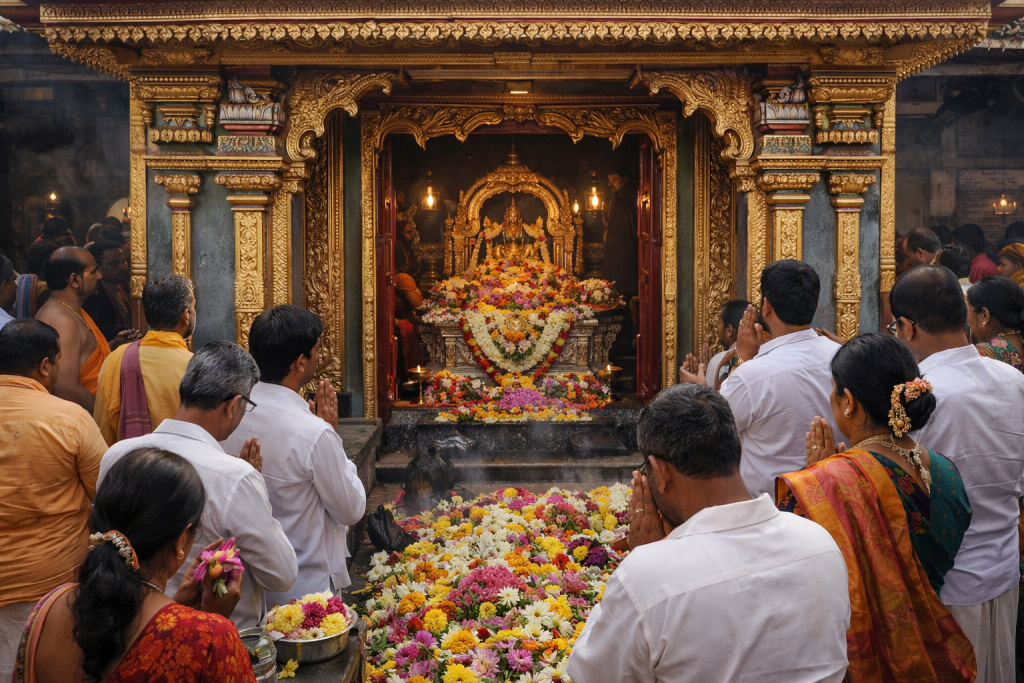
[Image 4: Devotees receiving blessings and prasadam near Mantralayam Moola Brindavan]
Scientific Observations at the Shrine
Several researchers have noted unusual phenomena at the Mantralayam Moola Brindavan:
- Temperature Variations: The area immediately around the Brindavan remains cooler than surroundings
- Electromagnetic Readings: Unusual energy patterns detected near the shrine
- Plant Growth: Tulsi plants near the Brindavan grow faster and healthier
- Acoustic Properties: Mantras chanted here seem to resonate differently
Quick Tip: Carry a small bottle of water from home. Place it near the Mantralayam Moola Brindavan during your darshan. This “blessed water” is considered powerful medicine for various ailments when consumed with faith.
Mantralayam Moola Brindavan Darshan Procedure
Getting the best darshan experience at the Mantralayam Moola Brindavan requires some planning. Let me guide you through the complete process.
Step-by-Step Darshan Guide
Step 1: Preparation Before Arrival
- Take bath and wear clean clothes (preferably traditional)
- Maintain a vegetarian diet for at least one day before visiting
- Keep your mind focused on your prayer intention
Step 2: Temple Entry
- Remove footwear at designated areas
- Wash hands and feet at provided facilities
- Purchase flowers, coconut, and camphor from shops outside
Step 3: Initial Prayers
- First visit the Panchamukhi Hanuman shrine
- Then proceed to the Manchalamma temple
- These preliminary prayers prepare you for Moola Brindavan darshan
Step 4: Mantralayam Moola Brindavan Darshan
- Join the queue leading to the main shrine
- When you reach the Brindavan, offer your flowers and prayers
- Touch the Brindavan if permitted and receive blessings
- Spend a few moments in silent prayer
Step 5: Completing the Visit
- Circle the Brindavan (pradakshina) at least once
- Collect prasadam from priests
- Visit the Rayara Mutt for additional blessings
Darshan Timings at Mantralayam Moola Brindavan
| Session | Timing | Best For |
|---|---|---|
| Morning | 6:00 AM – 12:00 PM | Peaceful darshan, less crowd |
| Afternoon | 12:00 PM – 2:00 PM | Temple closed for rest |
| Evening | 2:00 PM – 8:30 PM | Aarti experience |
| Special Days | Extended hours | Festival darshan |
VIP and Special Darshan Options
For devotees with time constraints, special darshan options are available:
- Seva Darshan: Perform a seva (ritual service) and get priority access
- Early Morning Darshan: Arrive before 6 AM for intimate experience
- Festival Darshan: Extended hours during Aradhana and other festivals
Pro Tip: The most powerful time for Mantralayam Moola Brindavan darshan is during Brahma Muhurta (4:30 AM – 6:00 AM). Though the temple opens at 6 AM, reaching early and meditating outside brings tremendous spiritual benefit.
Miracles and Divine Experiences at Moola Brindavan
The Mantralayam Moola Brindavan has been the site of countless documented miracles. These aren’t just ancient stories—miracles continue happening daily.
Famous Historical Miracles
The Blind Man Who Gained Sight (1892) A blind merchant from Raichur spent seven days praying at the Mantralayam Moola Brindavan. On the seventh day, he woke up with perfect vision. Medical records from that era document this case.
The Barren Couple Blessed with Twins (1956) After 15 years of marriage without children, a couple from Chennai performed Santana Gopala seva at the Mantralayam Moola Brindavan. Within a year, they were blessed with twin boys.
The Cancer Patient’s Recovery (1987) A devotee diagnosed with terminal cancer was given three months to live. After intensive prayers at the Mantralayam Moola Brindavan and consuming prasadam daily, subsequent tests showed complete remission.
Modern-Day Miracles Reported by Devotees
| Year | Miracle Type | Location of Devotee |
|---|---|---|
| 2019 | Court case resolved after 12 years | Mumbai |
| 2020 | COVID recovery against medical odds | Bangalore |
| 2021 | Lost child found within 24 hours | Hyderabad |
| 2022 | Business bankruptcy reversed | Chennai |
| 2023 | Rare disease cured completely | USA |
| 2024 | Family reconciliation after 8 years | Dubai |
Dreams and Visions of Sri Raghavendra Swamy
Many devotees who visit the Mantralayam Moola Brindavan report seeing the saint in their dreams—before, during, or after their visit. Common dream experiences include:
- The saint giving specific instructions or advice
- Receiving sacred items like rudraksha or holy ash
- Being told the solution to their problems
- Warnings about upcoming dangers
- Confirmation that prayers have been heard
Quick Tip: Keep a dream journal during your Mantralayam pilgrimage. Many devotees receive important messages through dreams after visiting the Mantralayam Moola Brindavan. Recording these immediately helps remember the guidance.
Mantralayam Moola Brindavan Architecture & Structure
The physical structure of the Mantralayam Moola Brindavan follows sacred architectural principles designed to maximize spiritual energy.
External Structure Details
The outer structure of the Mantralayam Moola Brindavan features:
| Element | Description | Spiritual Purpose |
|---|---|---|
| Shikhara (Tower) | Gold-plated gopuram | Directs cosmic energy downward |
| Prakara (Walls) | Stone enclosure | Creates sacred boundary |
| Mandapa (Hall) | Pillared gathering space | Congregation area for devotees |
| Dhwajasthamba | Flag post | Marks sacred territory |
| Tulsi Garden | Holy basil plants | Purifies surrounding energy |
Internal Configuration of the Brindavan
Though devotees cannot see inside, scriptures describe the Mantralayam Moola Brindavan’s interior:
- Position of the Saint: Seated in Padmasana (lotus position)
- Facing Direction: East, towards the rising sun
- Sacred Objects: 1,200 Salagramas surrounding the saint
- Manuscripts: Original philosophical works at his feet
- Protective Layers: Silver, copper, and stone encasements
Symbolism in the Architecture
Every element of the Mantralayam Moola Brindavan carries meaning:
- Square Base: Represents earthly stability
- Circular Top: Symbolizes heavenly perfection
- Gold Elements: Divine presence and purity
- Water Elements: Nearby Tungabhadra provides cleansing energy
- Directional Alignment: Maximizes cosmic energy receptio
Pro Tip: Walk around the Mantralayam Moola Brindavan observing each architectural element mindfully. This meditative circumambulation (pradakshina) is said to bring blessings equivalent to thousands of regular visits.
Best Time to Visit Mantralayam Moola Brindavan
Choosing the right time can significantly enhance your Mantralayam Moola Brindavan experience.
Seasonal Recommendations
| Season | Months | Crowd Level | Weather | Recommendation |
|---|---|---|---|---|
| Winter | October – February | Moderate | Pleasant (20-28°C) | Best Time |
| Summer | March – May | Low | Hot (35-45°C) | Avoid midday visits |
| Monsoon | June – September | Low-Moderate | Rainy | River views beautiful |
Special Occasions at Mantralayam Moola Brindavan
Aradhana Mahotsavam (August) The most important festival marks the anniversary of Sri Raghavendra Swamy entering the Mantralayam Moola Brindavan. Over 500,000 devotees visit during this three-day celebration.
Madhwa Navami (February) Celebrates Sri Madhwacharya, the founder of Dvaita philosophy that Sri Raghavendra Swamy propagated.
Guru Purnima (July) Special pujas honoring all spiritual teachers, with the Mantralayam Moola Brindavan receiving elaborate worship.
Vijayadashami (October) Marks the victory of good over evil, with special ceremonies at the Brindavan.
Auspicious Days for Mantralayam Moola Brindavan Darshan
| Day | Significance | Special Benefit |
|---|---|---|
| Thursday | Guru’s day | Career and education blessings |
| Saturday | Removes obstacles | Problem resolution |
| Ekadashi | Vishnu worship day | Spiritual advancement |
| Pournami | Full moon | Maximum energy at Brindavan |
| Amavasya | New moon | Ancestors’ blessings |
Quick Tip: If possible, plan your Mantralayam Moola Brindavan visit to include a Thursday. Staying for two nights allows you to experience both weekday peace and the special Thursday pujas.
Sevas and Rituals at the Sacred Brindavan
Performing sevas at the Mantralayam Moola Brindavan multiplies the blessings you receive. Here are the main rituals available.
Daily Sevas at Mantralayam Moola Brindavan
| Seva Name | Timing | Cost (INR) | Benefit |
|---|---|---|---|
| Suprabhatam | 5:30 AM | 500 | Auspicious start |
| Abhishekam | 6:30 AM | 1,000 | Purification |
| Alankara Seva | 7:30 AM | 750 | Divine decoration |
| Maha Puja | 11:00 AM | 2,000 | Complete worship |
| Rathotsava | Special days | 5,000 | Chariot procession |
| Dolotsava | Fridays | 1,500 | Swing ceremony |
Special Purpose Sevas
Santana Gopala Seva For couples seeking children. Performed at the Mantralayam Moola Brindavan with specific mantras for progeny blessings.
Vidya Puja For students seeking academic success. Includes special prayers to Sri Raghavendra Swamy, who was a renowned scholar.
Navagraha Shanti Planetary remedies performed near the Mantralayam Moola Brindavan for removing astrological obstacles.
Mrityunjaya Homa For health issues and longevity. The saint’s healing powers are invoked through this powerful fire ritual.
How to Book Sevas
- Online Booking: Through official Mantralayam temple website
- At Temple: Seva counter near main entrance
- Through Agents: Authorized temple representatives
- Phone Booking: Temple office numbers (verify current numbers)
Pro Tip: Book your seva at least one week in advance for weekends and one month for festivals. Some special sevas at the Mantralayam Moola Brindavan have limited daily slots.
How to Reach Mantralayam Moola Brindavan
Getting to the Mantralayam Moola Brindavan is straightforward with multiple transportation options.
By Air
| Nearest Airport | Distance | Travel Time | Transport |
|---|---|---|---|
| Kurnool Airport | 75 km | 1.5 hours | Taxi/Bus |
| Hyderabad Airport | 310 km | 5-6 hours | Taxi/Bus |
| Bangalore Airport | 380 km | 6-7 hours | Taxi/Bus |
By Train
The nearest railway station is Mantralayam Road (station code: MYMR), just 15 km from the Mantralayam Moola Brindavan.
Major trains include:
- Rayalaseema Express from Hyderabad
- Guntakal Junction connections
- Secunderabad-Hubli Express
By Road
| From | Distance | Time | Route |
|---|---|---|---|
| Hyderabad | 310 km | 5-6 hours | NH44 via Kurnool |
| Bangalore | 380 km | 6-7 hours | NH44 via Anantapur |
| Chennai | 500 km | 8-9 hours | Via Kurnool |
| Mumbai | 650 km | 10-11 hours | Via Solapur |
APSRTC Buses: Regular services from Hyderabad, Bangalore, and other major cities. Book through APSRTC official website.
Local Transport to Mantralayam Moola Brindavan
From Mantralayam Road station or bus stand:
- Auto-rickshaws: ₹100-150 to temple
- Shared autos: ₹30-50 per person
- Temple buses: Free during festivals
Quick Tip: If arriving by train, book a return ticket immediately as trains from this small station fill up quickly. Many devotees get stranded without advance booking.
Frequently Asked Questions
What is the significance of Mantralayam Moola Brindavan?
The Mantralayam Moola Brindavan is the original samadhi shrine of Sri Raghavendra Swamy, who entered jeeva samadhi in 1671 CE. Unlike regular tombs, the saint is believed to be alive in deep meditation, actively blessing devotees. The Mantralayam Moola Brindavan holds maximum spiritual power among the 700+ Brindavans dedicated to the saint because it contains his actual living presence. Devotees visit seeking solutions to health, financial, family, and spiritual problems, with countless documented miracles over 350 years.
Is Sri Raghavendra Swamy really alive in the Mantralayam Moola Brindavan?
According to scriptural evidence and eyewitness accounts, yes. When the Mantralayam Moola Brindavan was opened in 1801 CE—130 years after the saint entered samadhi—his body was found completely intact in meditation posture. The saint himself declared he would remain in this state for 700 years (until 2371 CE), blessing all who seek his help. The Mantralayam Moola Brindavan continues showing signs of life according to temple priests, including subtle movements and temperature variations.
What is the best time to visit Mantralayam Moola Brindavan?
The ideal time is October through February when weather is pleasant (20-28°C). For spiritual benefits, visit during Aradhana Mahotsavam (August), which marks the anniversary of the saint entering the Mantralayam Moola Brindavan. Thursdays are especially powerful as it’s considered Guru’s day. Early morning darshan (6:00-8:00 AM) offers peaceful, crowd-free access to the sacred shrine.